2,400W continuous, with headroom for refrigerators, washers, and other heavy household loads. Surge rating is 4,800W.
EF EcoFlow DELTA 3 Max · Model EF-DL-H02-3M
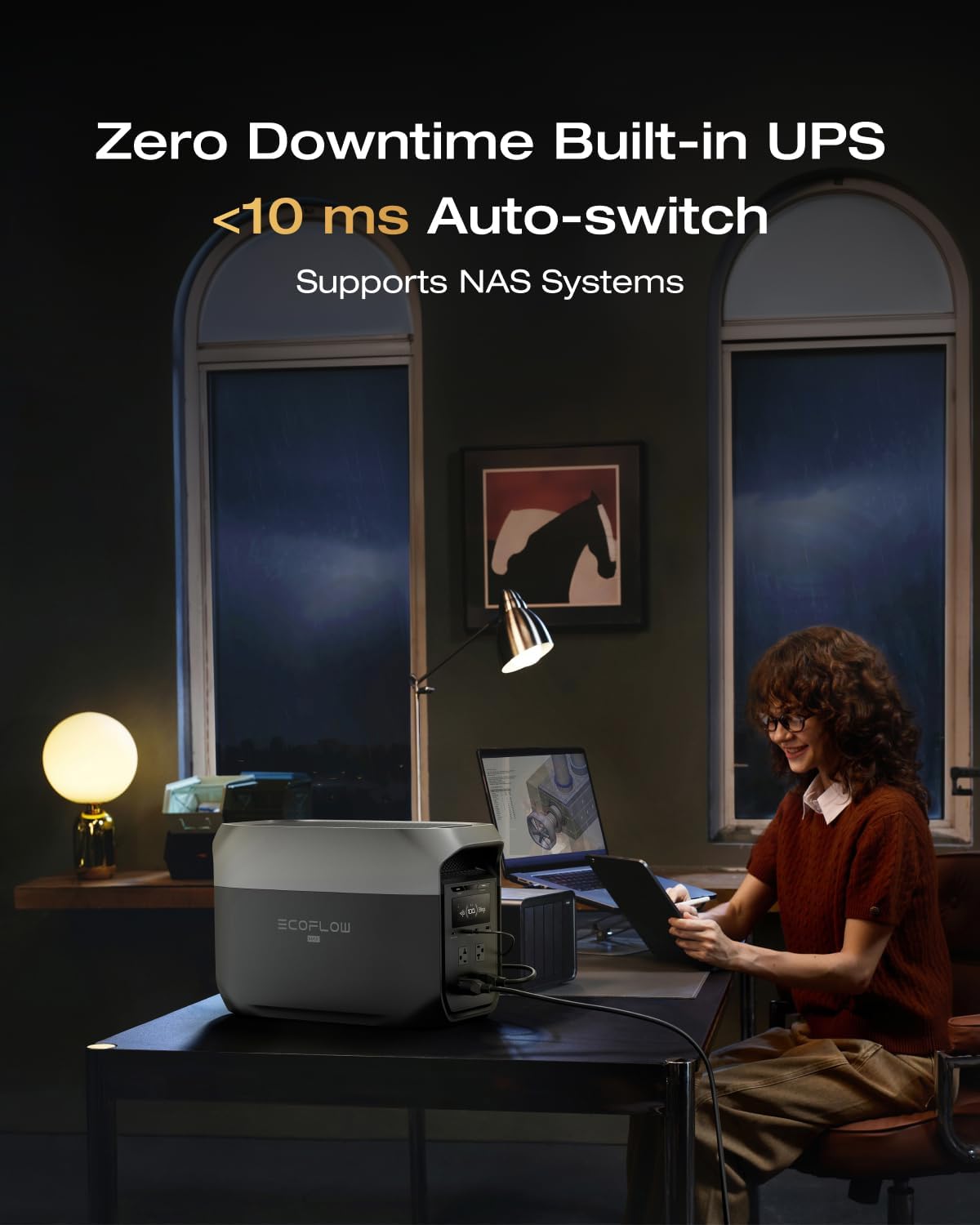
The grid drops. This station answers in 10 milliseconds.
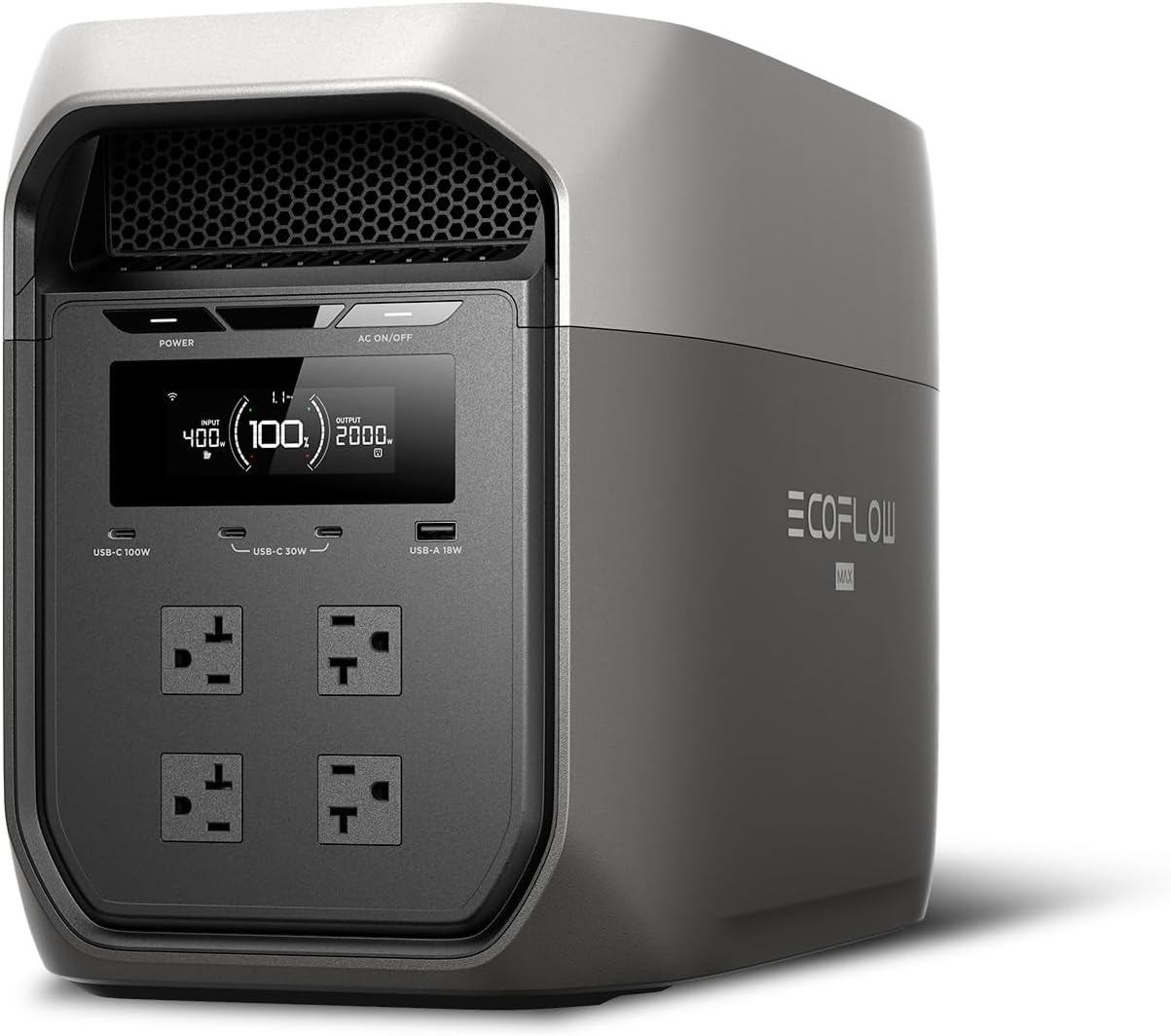
A 2,048Wh LiFePO4 portable power station with 2,400W of continuous output, 3,400W through X-Boost, and an X-Stream recharge that reaches 80% in about 1.13 hours. Built for the fridge, the desk, and the gear you notice the moment the room goes dark.
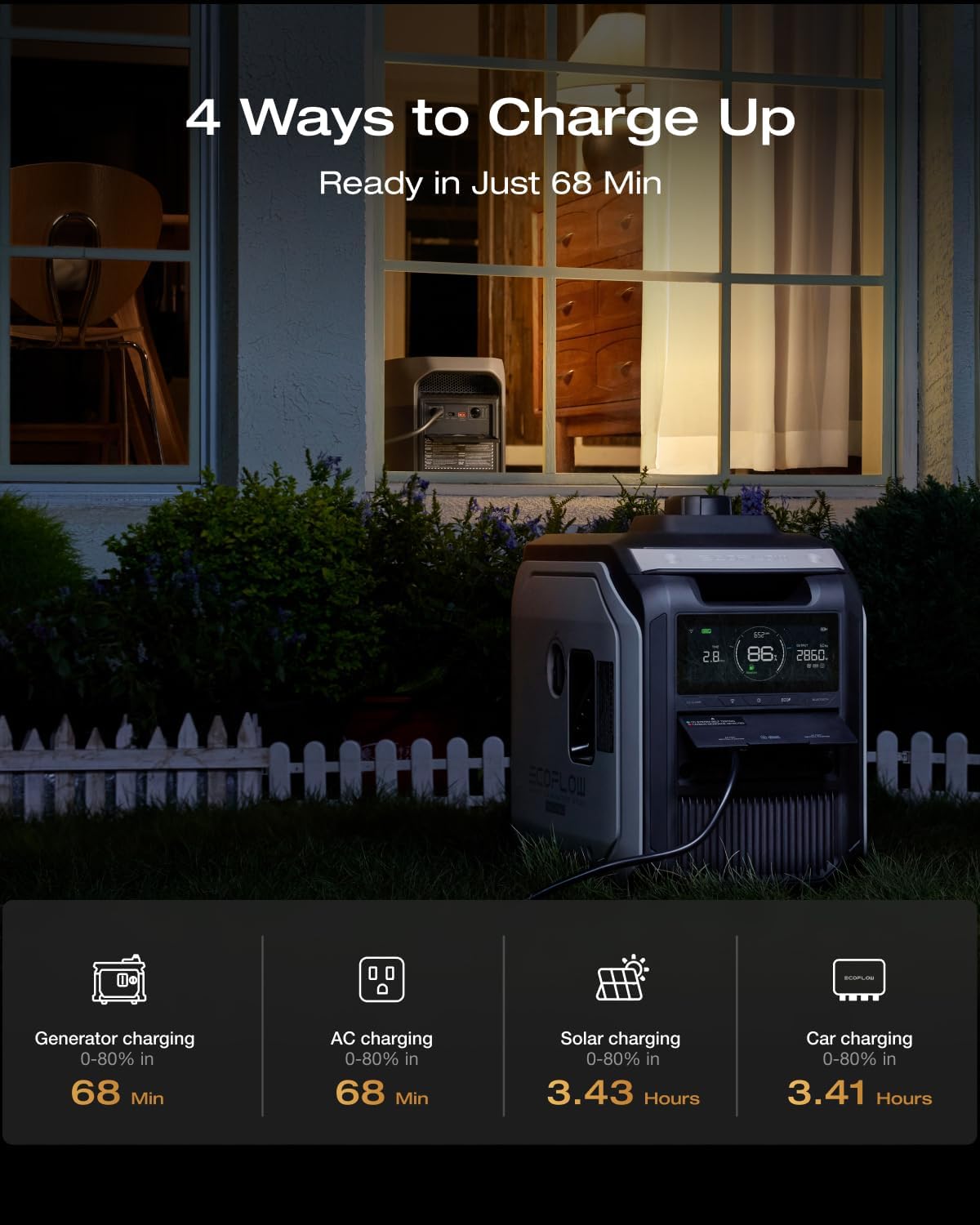
X-Stream wall charging reaches about 80% in 68 minutes. The box is ready again before the next band of weather.
Leave it between the wall and your critical outlets. The transfer is fast enough for many desktops, routers, and NAS devices.
FLASH
$879.00 sale price, down from $1,199.00 list. Confirm the number on Amazon before you buy. Marketplace prices move.
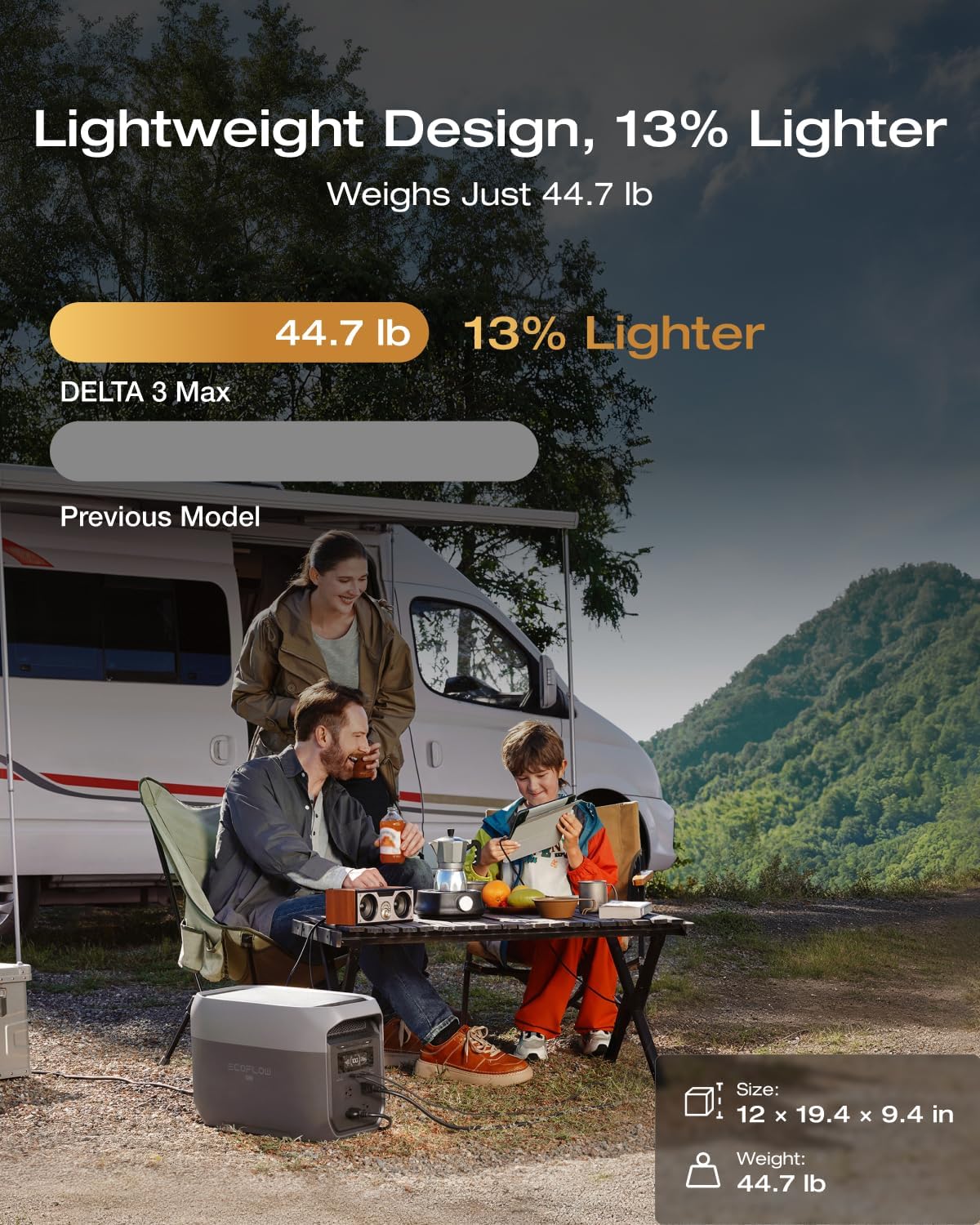
About 44.8 lb · 19.4 × 9.4 × 12.0 in (W × D × H) · ≤25 dB under 600W · 5-year warranty with app registration
4.9/5
Industrial verdict · October 2026
01 — Verdict
Buy it for a day of essentials. Skip it as a whole-home plant.
The score weighs continuous output, the 10ms transfer, the 1.13-hour path back to 80%, LiFePO4 chemistry, and the warranty. The missing tenth is real: X-Boost will not run every motor, solar input stops at 500W, and the full five years of coverage requires EcoFlow app registration.
Buy the DELTA 3 Max if
- An outage takes the refrigerator, the router, and a workstation at the same time, and you need them through the night.
- The station has to live indoors. It is IP20, LiFePO4, and has no exhaust.
- You will register the unit in the EcoFlow app. Standard coverage is 3 years. The extra 2 years, for a path up to 5, comes with that registration.
- You want the pack full again the same day. Wall charging hits about 80% in 68 minutes.
Skip it if
- The job is a central air conditioner, an electric range, or a well pump that sits past 3,400W or needs a 240V circuit.
- You want several days of whole-home power from one box. 2,048Wh is a day of chosen loads, not a house.
- You only need phones and a lantern. This capacity and this price are built for household appliances.
- The listing is a third-party or gray-market seller. Warranty support and pack condition get murky there.
02 — Why it works
Three specs that change an outage, and the limits attached to each.
EcoFlow’s DELTA 3 Max documentation is specific. The useful version of those numbers includes the asterisks.
Output
3,400W X-Boost
2,400W continuous
The listing title rates this station at 2,400W. That is the continuous AC output: 120V, four outlets, 20A maximum on any single port. X-Boost 3.0 is the separate 3,400W mode for loads that tolerate a controlled voltage dip, such as many refrigerators, heaters, washers, and circular saws. A spec field on the same Amazon page lists “running wattage” as 3,400W. That field is X-Boost, not the continuous rating. Motor starts can call on a 4,800W surge.
EcoFlow’s manual is plain about the limit. X-Boost suits heating devices. Equipment with strict low-voltage protection can shut itself off. Run the refrigerator once, on a calm afternoon, before you trust it in a storm.
X-Stream charge
1.13 hours to 80%
68 minutes
That 1.13-hour figure is the wall-charge sprint from empty to about 80%, not a promise of 0–100%. The listing graphic gives the same 68 minutes to generator charging. Solar input, capped at 500W, is shown at 3.43 hours to 80%. Car charging through the XT60i port is shown at 3.41 hours to 80%. On a US outlet the AC input is 100–120V at up to 15A.
Between outage bands, you are not waiting overnight. Plug it back into the wall when the grid returns and the station is mostly full before the next coffee.
Transfer
10ms auto EPS
10 milliseconds
Keep the station plugged into the wall, and keep the critical strip plugged into the station. The listing says the handoff takes less than 10ms. EcoFlow rates that auto-switch at 10ms and cites it for NAS systems and servers. A desktop and a modem usually stay in the session.
While the grid is up, US bypass is 13A total, about 1,500W of pass-through. Size the always-on strip for that ceiling. The full 2,400W is the battery-inverter rating after the grid is gone. This is an EPS switch, not a double-conversion medical UPS.
- Capacity
- 2,048Wh · 51.2V · 40Ah LiFePO4
- AC output
- 120V, 60Hz, 2,400W total, pure sine, 4 outlets, 20A max each
- USB
- Front panel: USB-C 100W, USB-C 30W, USB-A 18W
- X-Boost
- Up to 3,400W for compatible loads, not the continuous rating
- Surge
- 4,800W
- Wall charge
- 0–80% in 68 minutes. Generator charging matches that.
- Solar / car
- 500W max, 11–60V XT60i. About 3.43 hours to 80% on solar, 3.41 hours by car.
- EPS
- 10ms auto-switch. The listing says under 10ms.
- Noise
- 25 dB when the load is under 600W
- Body
- About 44.8 lb (20.3 kg). 19.4 × 9.4 × 12.0 in, width × depth × height. IP20.
- Warranty
- Listing: 5-year manufacturer. EcoFlow terms: 3 years, plus 2 after app registration.
03 — Appliance performance
What 2,048Wh actually covers when the street goes dark.
These are planning estimates, not lab runs. They assume about 85% of the nameplate watt-hours reach the appliance after inverter losses. A hot kitchen, an old compressor, or a heated humidifier will spend the pack faster.
Kitchen
Refrigerator
Strong fit
About one day, fridge only
A modern refrigerator often averages near 1–1.5 kWh across a full day, even though the compressor spikes well above its running watts. One efficient fridge, with the door staying shut, is the right job for this pack. An older unit in a warm room can finish the battery sooner.
- Running draw
- Often 100–200W
- Start surge
- Why the 4,800W surge exists
- X-Boost
- Test it once before storm season
Set AC timeout to Never in the EcoFlow app. The manual notes that an idle AC port can switch off between compressor cycles. That setting matters if the fridge is holding medicine or food.
Work
Remote desk
Strong fit
About 14–18 hours
A laptop, one monitor, a router, and a lamp usually land between 80 and 150W. At the middle of that range the pack covers a long workday and the evening after it. The 10ms transfer is the point: the call and the document survive the cut instead of rebooting into a dead modem.
- Planning load
- About 100W combined
- Usable energy
- ~1,740Wh after losses
- Phones
- Use the USB ports, not the inverter
Keep the modem on the station, not on a separate strip. A live laptop on a dead router is still an outage.
Home health
Medical hardware
Conditional fit
Several nights on CPAP alone
A CPAP without heat or humidity often draws about 30–70W. On that load, 2,048Wh can cover multiple nights if nothing else shares the station. A heated hose and humidifier can push the draw near or above 90W and cut that window toward one or two nights. Output is pure sine, which is the waveform most electronics expect.
- Waveform
- Pure sine, 120V
- Transfer
- 10ms EPS, not a medical UPS
- Share the pack
- Every extra watt shortens the night
This station is not a life-support device. Confirm runtime, alarms, and transfer tolerance with the device maker and your clinician before you rely on it for any medical equipment.
04 — Fakes vs. real
The warranty lives or dies on who sells the unit.
A gray-market DELTA 3 Max can look identical on the listing photo and still arrive as the wrong region, a used pack, or a serial EcoFlow will not support in the United States.
Treat these as warning signs
- The seller name is neither EcoFlow nor Amazon, and the price sits far under the current official sale with no explanation.
- The listing is vague about condition: “new” photos, refurbished language, or a missing warranty card in the description.
- The plug, manual, or model region does not match a US 120V unit. This station’s US output is 120V, 60Hz.
- There is no clean path to EcoFlow app registration, which is how the coverage extends from 3 years toward 5.
How the buttons on this page route
- Every price button and every product plate uses one affiliate link to the Amazon listing.
- On the Amazon page, read the seller line before you pay. Buy from the official EcoFlow storefront on that listing.
- When it arrives, register the serial number in the EcoFlow app so the extended warranty years are actually attached.
- Keep the listing’s packaging and the in-box warranty card. Gray-market disputes get harder without them.
Use this page’s link, then confirm the storefront at checkout. The sale shown here is about $879.00 against a $1,199.00 list price.
Open the Amazon listing05 — FAQ
Indoor use, solar, and how long the pack is meant to last.
Can I run the DELTA 3 Max indoors?
Yes. It is an IP20 LiFePO4 station with no engine and no carbon monoxide. That is the reason it can sit in a living space when a gas generator cannot.
Leave the vents clear. Do not run it in a closed closet, under a blanket, or in a parked car. Optimal operating temperature is 68–86°F. It can charge from 32–113°F and discharge from 14–113°F. The 25 dB figure applies when the load is under 600W. Heavier appliances spin the fans harder, so a full 2,400W draw will not stay at a whisper.
Which solar panels are compatible?
The station has one XT60i port that accepts solar or car charging. Solar input is 11–60V and 500W maximum. EcoFlow’s manual requires the array’s total open-circuit voltage to stay within 60V and the total short-circuit current within 18A. Exceeding either can damage the input.
Use an EcoFlow solar-to-XT60i cable. Series wiring adds voltage, which is the usual way a pair of panels slips past 60V. A single portable panel in the 220–400W class is the practical match. At a full 500W, the listing graphic puts solar charging at 3.43 hours to 80%. The same graphic puts car charging at 3.41 hours to 80%. Both assume real input at the rated level, not a cloudy afternoon.
How long does the LiFePO4 battery last?
EcoFlow uses automotive-grade LFP cells in this model and describes about 10 years of service when the pack is cared for. LFP is the chemistry that holds capacity across years of cycling better than the older packs that faded after a few hundred deep cycles.
The warranty is separate from that service life. The Amazon listing calls it a 5-year manufacturer warranty. EcoFlow’s terms split that into 3 years standard and 2 more after you register the unit in the EcoFlow app. Store it between 14°F and 113°F, ideally near room temperature, and avoid leaving it empty or full for months at a time. Heat is what ages these cells early.